
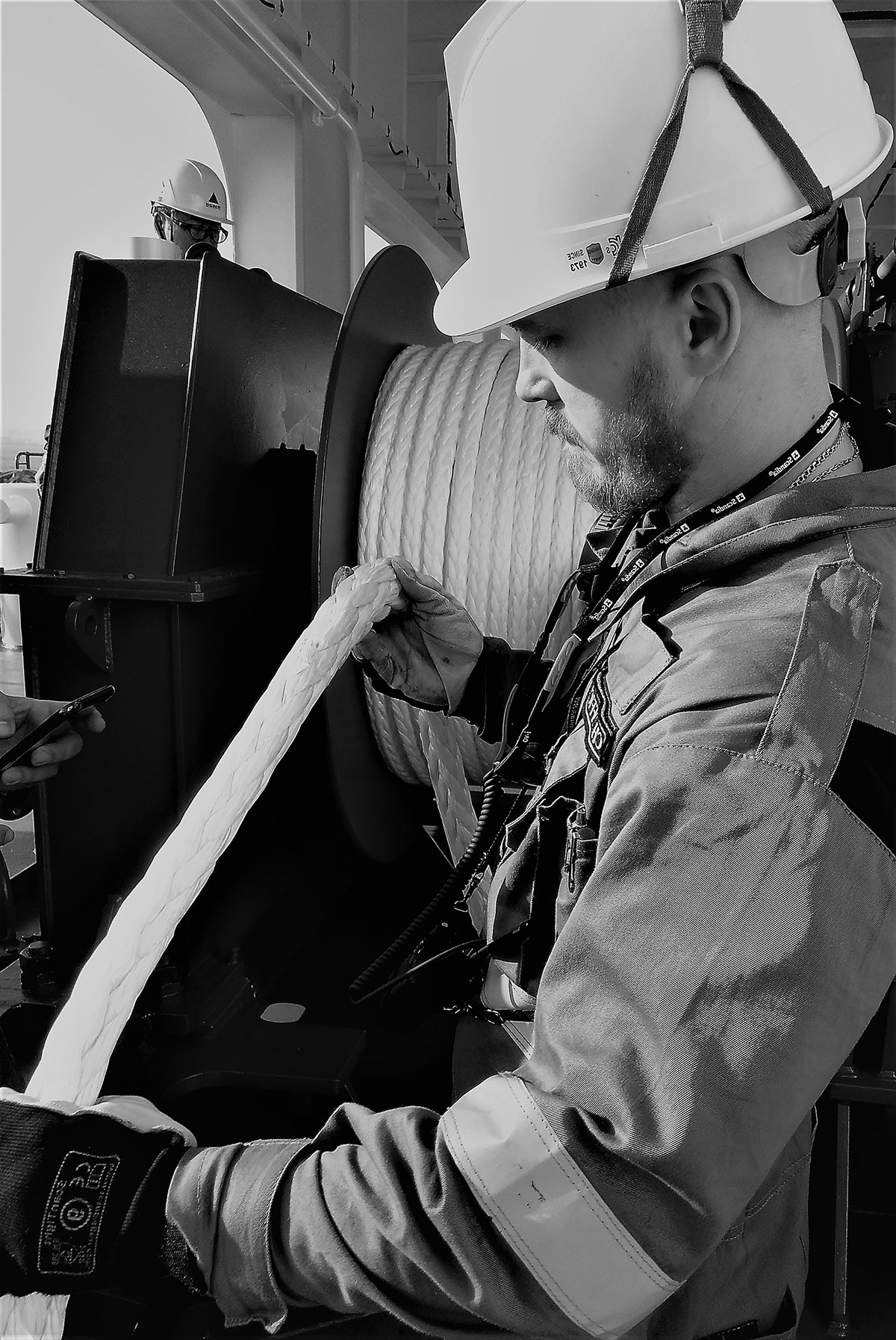
Tips of mooring lines inspections
acc. to MEG4
Conducting ongoing inspections of the mooring line system is a vital task to ensure the maximum service life and safety in every setup. It is important to be aware of and to define when inspections are to be undertaken and by whom.
1. Regular inspections by mooring crew members – upon each use
A visual inspection should be carried out by crew members prior to and during every mooring cycle in order to check for any damage. The inspection should follow the procedure of the checklist provided on page 25 of this manual. A logbook is to be maintained for each inspection and, if necessary, entries should be made to record any incidents, irregularities or observations. The defined rope retirement criteria are to be strictly observed.
2. Routine inspections by a qualified person – after the completion of mooring operation
The OCIMF MEG4 guideline prescribes that a routine inspection must be undertaken after the completion of mooring operation. Only qualified persons may conduct such inspections, who are in possession of a recognized degree or certificate of professional standing in an applicable field, or, who by extensive knowledge, training and experience have successfully demonstrated the ability to solve problems relating to the subject matter and work. During routine inspections, the qualified inspectors should walk the entire length of the line as well as the tail, to examine and document the current condition – and take any further necessary action.
3. Detailed inspections by a qualified person – after the 1000 mooring hours or after 30 mooring operations
The OCIMF MEG4 guideline prescribes that a detailed inspection must be undertaken after the 1000 mooring hours or after 30 mooring operations. Only qualified persons may conduct such inspections, who are in possession of a recognized degree or certificate of professional standing in an applicable field, or, who by extensive knowledge, training and experience have successfully demonstrated the ability to solve problems relating to the subject matter and work. During routine inspections, the qualified inspectors should walk the entire length of the line as well as the tail, to examine and document the current condition – and take any further necessary action.

Visual inspection
All types of wear and damage to the mooring line are to be identified by the mooring crew or a qualified person.
Walk the entire length of the rope and document its overall condition. Special attention is to be paid to contact points on deck, mainly with fairleads, as well as the cross point of split drums.
1. Abrasion/ cuts
2. Kinks/twisting/deformation
3. Inconsistent diameter
4. Glossy or glazed sections
5. Discoloration
6. Compression
7. Strand/ yarn breakages
8. Deformation caused by heat
9. Damage to splices
10. Other types of mechanical damage such as strong wear or general disaggregation
Refer to the examples of damage section in the appendix of this manual for further information on rope retirement recommendations.
Inspections following special incidents Should one of the following instances occur, the mooring line must be immediately inspected by a qualified person!
• Suspected exposure to an excessive shock load
• Clearly audible “cracking” of the mooring line
• Exposure to chemicals
• Unexpectedly strong twisting
• External mechanical damage
Wear zone management
Maximize safety and mooring system service life by ensuring all operators have a high level of awareness of the factors that cause rope damage and that appropriate precautions are taken to avoid damage.
Wear zone management. Mooring line systems are subjected to potential damage day in, day out, due to regular mooring activities. Also having an effect on this are the individual trading patterns of the ship including the design of the terminals being berthed at, the specific type of mooring system setup, the environmental conditions and ship movements while in port as well as the degree to which the ship is loaded. As the wear zone management techniques will vary with each vessel, it is important that these are assessed for each application and documented within the LMP in order to reduce the risk of rope damage most effectively.
Some effective techniques that can be included in an LMP to manage the wear zone include ensuring that:
1. Deck fittings are smooth to ensure mechanical damage is avoided
2. All sections of the mooring line system are protected from the elements and other environmental damage when not in use
3. Sharp deflections are avoided and that the D/d ratio is maximized
4. Interaction with deck fittings is controlled as swell, waves and wind will influence rope fatigue
5. Insufficient wraps around drums are avoided to minimize slippage
6. Mooring system lines are turned and interchanged to enable abrasion to occur evenly on rope sections
info@blackrope.com , (+30) 69522 90682-3-4


